divendres, 17 d’agost del 2012

More hatchlings


The two eggs incubated at 25ºC in a home made incubator (see older posts) hatched in August de 14th. The incubation lasted 64 days. So, the first clutch of eggs have hatched in both types of incubator. I have the loggers data but I will post it when I have all the data, for comparison.
The cheap home made incubator works quite well. The temperatures have been always kept between 25-26ºC and the humidity is very high (this could be a problem in non aquatic species).
There are still three eggs incubating . One in a Jaeguer incubator at 25ºC, a second one in a home made incubator at 30ºC and the third eggs is incubating outdoors in the nest.
The one in the home made incubator at 30ºC has been there for  52 days. At the same temperature in a Jaeguer incubator, the eggs of the first clutch hatched in 46 days. 
What is happening with the egg outdoors is a mystery. This summer is being quite hot, with several days with maximum air temperatures in the shadow close to the 40ºC.  It is not temperature but humidity what is worrying me. For what I have seen in the incubators, a high humidity is important. I don't know what is happening regarding humidity at some depth surrounded by earth, but the surface looks dry. For this reason I water the nest area every other day and every day in especially hot periods.

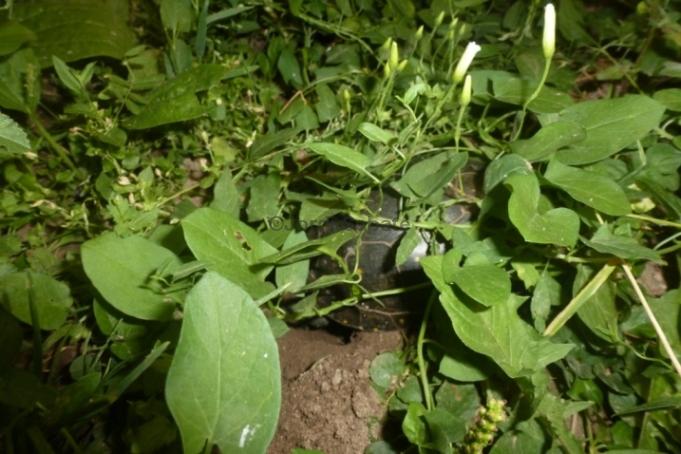
The first pictures of the hatchlings have not been good. This is one of them, already in the tank


The hatchling is in the middle of the picture


A mesh protects them from cats and corvids

None of the hatchlings has eaten anything of what I have offered them. The male born last summer did the same. He entered hibernation and only this spring he started eating earthworms and pudding. In spite of this he grew a little bit before hibernation. I imagine it is explained for the viteline reserves plus some mosquito larvae he could eat.  I have seen him doing it this summer, stretching the neck as fast as he can.
I will keep offering them food, they will do what they like.

dilluns, 30 de juliol del 2012

First hatchlings 2012

Two terrapins from the clutch laid in June the 11th have hatched. These two eggs were incubated at high temperature, nearly 30ºC. The first one was born on July the 25th and the second one the 26th. This last one corresponds to the egg that deformed a little bit some days ago.
According to the book  "Turtles of the United States and Canada" the natural incubation usually lasts 50-90 days, although in captivity it can take only  44 days. With mine, it has been 45 and 46 days.
They are usually born with a spot in each scute except the first cervical that has none. This is what happened with last year hatchling, incubated at lower temperature and probably lower humidity. This time both terrapins have more than one spot in some scutes.


The first hatchling


The same animal


The "egg tooth"


The second terrapin peeping from inside the egg
The second hatchling


I put them in humid paper until they absorbed the viteline sac (around 28 hours). I already keep them outdoors, in a fiberglass tank with little water and a plant in the middle. The terrapins hide under the roots and the algae. There are some mosquito larvae that will hopefully be their first food.
I haven't put them with their brother born in 2011. I don't trust him, he is bigger and those long tails could be confused with food.
I now realize how much has last year's hatchling grown in a year

When they are born the spots are not yellow. 


It is easy to see the growth in the shields


It didn't take the food that I offered him until this last spring. Then it only ate earthworms, insects... One day he tasted the pudding and now he eats it as well.


With this size he begins to behave like the adults, sunbathing on a log. I didn't see him doing it when he was smaller. In spite of this he is still very shy. When he sees me, he drops to the water and hides under the vegetation.
The adults relate me with the food. They swim away if I am too close but they keep an eye on me, just in case I throw some food. The hatchling doesn't relate me with food yet and stays hidden.

dimarts, 24 de juliol del 2012

The egg has recovered

The day after adding water to the vermiculite, the egg had a normal shape again. Good news I think.


divendres, 20 de juliol del 2012

Incubation

Today I encountered something disturbing: one of the eggs incubated for female was collapsing from the sides. This was happening in spite of keeping it in humid vermiculite in a closed box of crickets.

The positive side is that, looking at it with a torch from below, the egg looks full.

I do not turn it and I light it from below


    The terrapin occupies all the egg
This usually happens when the humidity is not high enough. I have moistened the vermiculite and I have covered the eggs a little bit more. Now I have to wait, although I have lost some hope with this egg.
One curious thing is the change in the shell hardiness during incubation. Recently hatched they are hard, they look like those of hard shelled egg species. By now, they are very soft, as though there was only a thin membrane.

dimarts, 17 de juliol del 2012

David Carroll's books

Carroll's books are not conventional books about turtles. They describe a wild animal in a wild environment. They do not explain how to keep a turtle, actually they are far from that, but precisely for that I strongly recommend them.
Carroll is an artist and the books are full of his drawings.
There is a phrase by Jordi Sabater Pi, ethologist and primatologist, who also used to draw the animals he studied:
Who draws, observes; who observes, knows; who knows, loves and who loves respects and protects.


dimarts, 3 de juliol del 2012

A second clutch

On Saturday evening, at a quarter past nine, I saw the female digging a nest. She was very well hidden among the bindweed and I didn't see her at the first glance.

I found her thanks to the little movements she made. Under the arrow you can see one little yellow spot.


Last year she made a nest in the same place. Here the soil is mixed with fine sand. Some weeks ago she did it on the other side of the pond, in very hard soil.

A picture from another side.


The fist egg


The third egg


She is gently putting them in place


Covering the nest

By midnight she was back to the water and the nest was completely covered.
She has repeated last summer clutches: a first one of 4 eggs and a second one of 3 eggs.

This time I have put one egg in a Jaeguer incubator at 26ºC and another egg in a home made incubator like the one I described in the first clutch (aquarium heater), at 30ºC.
Now I have eggs incubated for female in both type of incubators. The same for eggs incubated for male. I will be able to compare both types.
I have left the third egg in the nest. Very close to it, in the space left by one of the eggs that I collected, I put a data logger to measure the temperature every hour for all the incubation.  The only  intervention that I will make is watering the ground if it is very dry and protect the nest with a wire mesh. 

divendres, 29 de juny del 2012

She carries more eggs

Last Monday, 15 days after the female laid, I palpated her inguinal and I felt eggs again. I haven't noticed behavioral changes, such as stop feeding or visiting the land area. As I always do when I palpate she carries eggs, I have a look at the land area in the evening, in case she is making the nest. Also,  every few days I palpate her.

These days we are having a heat wave and the maximum temperatures in the shadow are very close to 40ºC. Yesterday evening, at 21:00, we were 29ºC. This is more typical of the "canicula" (dog days) than June.  Fortunately the vegetation covers half of the pond creating shadow. I also have the measurement of last summer water temperatures in the hottest days, so, I don't think the terrapins are in danger. Every two days I add some water as the evaporation looses are important.

It is curious to see the behavior of some animals in these hot days. The terrapins are very inactive. On the other hand, Paper Wasps  (Polistes dominulus) are extremely active. They visit the pond in great numbers, looking for the water. They use it to thermo regulate their nests, cooling it through evaporation. They often stop on rocks or vegetation, but sometimes they land on the water taking advantage of the surface tension, the same way as pond skaters do. In the beginning I was concerned that the terrapins tried to eat them. Over time I have seen that they completely ignore them. I guess the aposematic coloration of wasps reminds them other wasp species native to their habitat and they "know" it is better not to disturb them.