dimecres, 7 de novembre del 2012

Ready for the hibernation

The turtles feel the winter is coming. In September I saw them occasionally. They stopped eating in mid-month. I haven't seen them since then. Maintenance work limits to picking up the leaves that fall on the water.
The hatchlings also remain hidden. Night temperatures are close to the 0ºC, so, I took them out of the tank where I had them to hibernate in a safer place (cold but out of reach of frost). I found all the hatchlings between the roots of  a plant, near the surface.


In the tank, if it was cold enough, frost could reach all the water. They are now in a bucket with little water and algae in a garden shed.


I also weighted and measured them, so, these data are from the first week of November 2012

BirthLength (mm)Width (mm)Height (mm)Weight (g)
August 2011    44,58   41,32   15,4713
August 2012     33,24   31,23   12,146
August 2012     31,65   31,24   12,26
August 2012     30,85   29,51   11,075
August 2012     32,92   31,26   12,116
August 2012     32,58   30,9   12,445
August 2012     31,43   29,52   12,425
Sept. 2012           27,8   26,41   11,854


I am planning to build a new pond for the male. He chases the female whenever he sees her. I think this could be stressful for her, and I don't think this is a normal situation in the wild. In the books they say this species uses different ponds in different seasons. In spring they leave the waters where they have been hibernating and migrate to ponds. These congregation of animals in the same pond are useful in the mating season, when the sexes meet easily. Later, in the laying season, the animals would disperse.
I guess that once the animal have dispersed , males  chasing females would be only occasional, when they met casually. So, I think the best option would be to have a pond for the male and a pond for the female. Probably in the female's pond there could be more than one female. In the male's pond there should be only one male. In spring I would put the male with the female until the laying season.

This November two herpetological conferences will take place in Spain:

The one of the Societat Catalana d'Herpetologia (SCH) about reptiles and amphibians


And the one of the Sociedad Herpetológica Valenciana (SOHEVA) about chelonians

dilluns, 24 de setembre del 2012

The terrapin incubating outdoors hatched

The egg that was incubating outdoors has hatched. But I have to confess that I cheated. 
There was a problem: now that autumn is near the sun goes lower and my neighbor's house makes a shadow on the nest area until noon. At the same time the day is shortening and the last days were cool. Last week I couldn't resist any more and I dig the nest to see what was going on.
The egg was buried at a depth of  4,5cm. It looked all right, alive. I torched it and I saw there was a terrapin, but it didn't move and I didn't not if it was alive.  Part of the egg looked empty and I thought the terrapin was immature . I put it in the incubator at 28ºC. To my surprise, next morning, before the 24 hours, the terrapin was hatching. 
Now I regret having taken the egg as it has altered the experiment. Anyway, seeing the graphs and thinking about what has happened, I am sure the terrapin was already fully developed and it just needed some temperature to hatch. I am sure it would have hatched last weekend as it has been quite warm. Next summer I will be more patient.
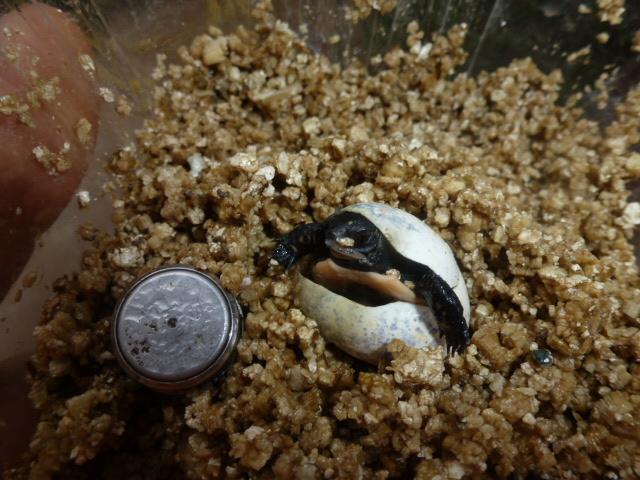
 
The data logger has always been with the egg


Watching the terrapin has been a pleasure, but this time I was even more interested in the data logger data. Just a brief description of the situation:
  • The nest was at 4,5 cm depth. The data logger just by the egg.
  • The hottest days I watered the nest area, just in case it dried too much (it was very exposed to the sun and it has been a very hot summer). But I didn't want to alter the nest temperature. So I watered in the morning, when passed the night, the ground had lost the heat accumulated during the day.
  • In September there was a stormy afternoon. For a couple of hours it rained so much that I thought it could be too much even for a terrapin hatch.
  • I put a data logger on the surface, to measure the air temperature. I couldn't put it exposed to the sun as it would overheat and the data would be wrong. So I protected it with a piece of wood but letting the air pass. The measured temperature is the one of the air about 7 cm from the ground. It is not the same than the one of the weather stations. These measure the temperature in standardized conditions so that they can compare the data in all the country. I have measured the temperature of a microclimate, an specific area of the pond, very close to the nest. In this case, the radiating temperature coming from the ground, the stones... can affect the data logger, but this is a more real situation for a terrapin, that would also experience those radiating temperatures. It is useful to compare what is happening inside the nest and outside the nest.
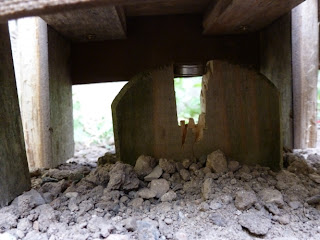

.
And these are the temperatures that this data logger has measured , in the shadow, close to the nest, between the 1st of July and the 31st of August.


The maximum temperature has been 43,73ºC. The minimum 12,11ºC. The mean temperature 25,2ºC. Almost every day temperatures were over 30ºC, often over 35ºC. The minimum have moved between  15 and 22ºC but one day they reached 12,11ºC.
And these are the temperatures of September from day 1 to a couple of days after hatching.
 
The mean temperature has been 18,54ºC. The maximum 32,38ºC and the minimum 10,99ºC.
 
And this is what was happening underground, at 4,5 cm depth, in the nest, from the beginning of incubation until the end (the last peak corresponds to the incubator)


The maximum temperature has been 32,75ºC the 21st of August. That day, on the shadow, temperatures reached 43,73ºC. I don't know the ground surface temperature over the nest, exposed to the sun, but I am sure it was much higher than the 43,73ºC. It is curious to see how does the temperature go down at just  4,5 cm depth.
The minimum temperature has been 14,36ºC. On the shadow the temperature was 10,99ºC.
During the incubation the temperatures were below  22ºC part of the day as you can see in the graph. Some days they were over the 28ºC. Five days they passed the 30ºC and three days they passed the 32ºC.
16 days the temperatures were below 18ºC for some hours, five days, also for some hours, they were below 16ºC.
Four days the maximum temperature didn't reach the 22ºC.
The mean temperature during the incubation has been 22,69ºC.
Would you buy an incubator like that?

Is it a male or a female?
In this species sex determination depends on the temperature when the gonads are developing. In Ernst&Lovich book it says at 22.5-27ºC males predominate, while over  30ºC they are always female. But as you can see in the graph we don't have a constant temperature. In a same day the temperature changes a lot. You can begin the day at incubating temperatures for male and at noon reach incubating temperature for female.

There are more peaks below than over 28ºC. It looks like male.

On the other hand, it is said that sex determination takes place in the middle third of incubation, when the gonads are developing. The incubation lasted 83 days. It started on the 1st of July. The middle third corresponds to the period between July the 28th and August the 24th. I will look at what happened in that period.

In the beginning I thought I needed the mean temperature.
The mean temperature in the middle third of incubation, (July 28 to August  24) is 24,61ºC.

Then I thought you can calculate it another way. Ernst and Lovich talk of incubation temperatures between 22.5ºC and over 30ºC. Gunther Köhler says 23-30ºC (in a very interesting book: Incubation of reptile eggs). As we see in the graph the egg has been below 22,5ºC several hours. Under this temperature the egg stops or slows dowm development. If we ignore those temperature when we calculate the mean incubating temperature, the result is 25,2ºC, not that much higher.

The mean temperatures are low. It looks again as it is a male. But there is something that I think is strange: we have had one of the hottest summers for decades. Common sense says if you have a very hot summer, the eggs are probably going to be females. In the middle third of incubation , the air temperature in the shadow has been almost every day over 30ºC, often over 35ºC and sometimes over  40ºC. The minimum temperatures have been most of the days over  20ºC and when they were below it, it was only for a few hours. This means heat. In spite of this, it looks as though it is a male. What happens in Canada, what sort of summers do they have? What are the air temperature needed (specially nocturnal) to reach a mean temperature of 29-30ºC in the nest?.

Maybe it is not the mean temperature what is important. Maybe it is the peak temperatures in a certain moment, or a number of hours over a certain temperature, or something else. At the end, what is happening in natural incubation is very different from artificial incubation.

Anyway I won't know until the terrapin reaches sexual maturity of I find information about it in a book or an article.

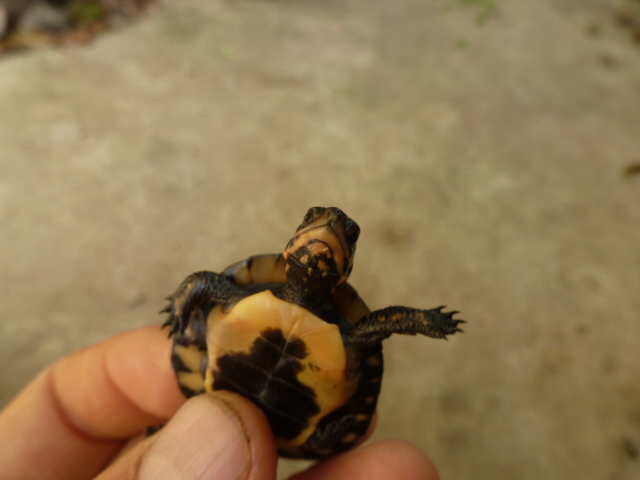
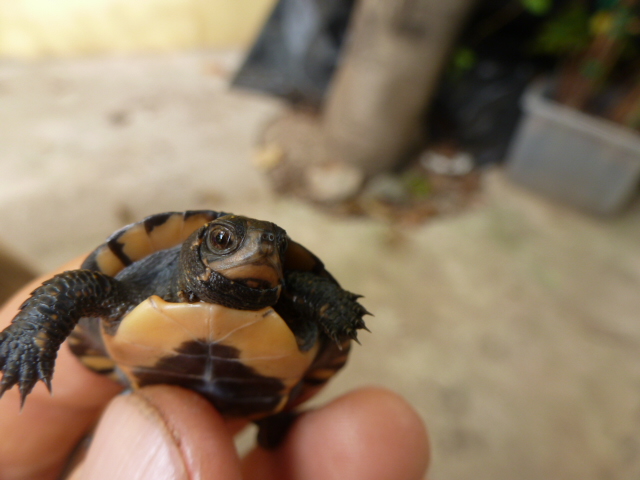
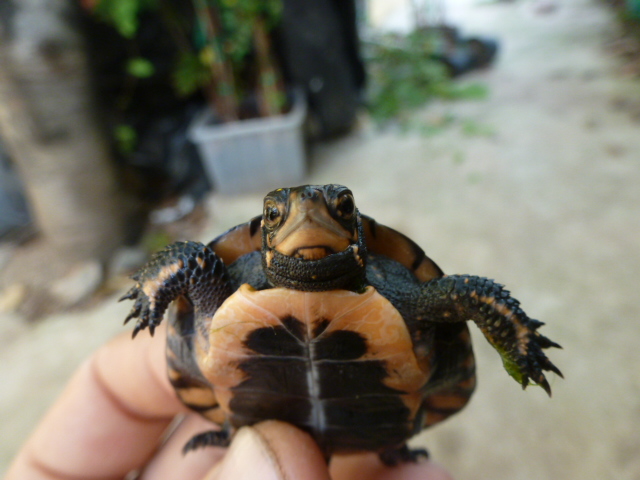
Talking about sex, someone told me you could sex Clemmys hatchlings by the chin color. I haven't found any conclusive difference between males and females at that age.

Female 2012

Male 2012
Female 2012
Male 2011

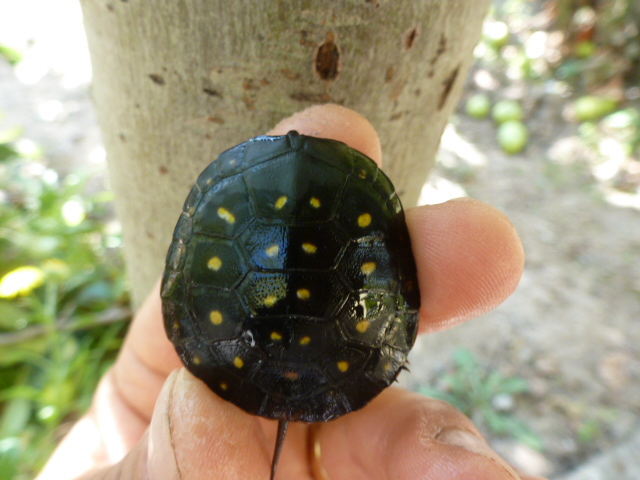
Regarding hatchlings coloration, the older ones already have the yellow spots. A comparison between a recently hatched and the ones born last month. With time the color appears.
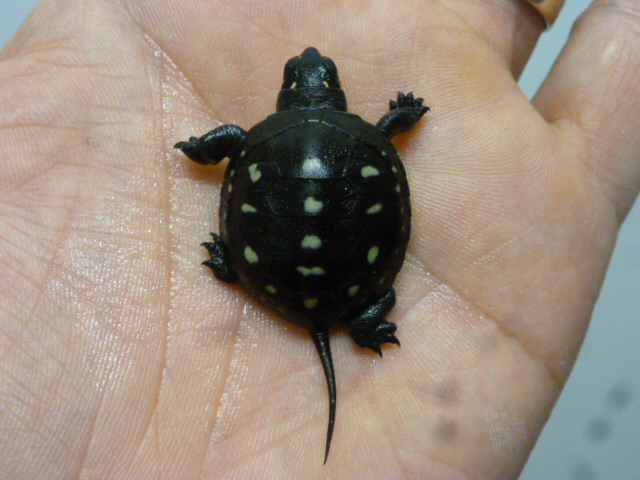
 
Born yesterday, rounded in shape, with very pale spots
Born in August, already flattened and with the spots already yellow
I have also noticed that some of the hatchlings have the 5th vertebral scute spot orange instead or yellow. Some terrapins also have the supracaudal scutes brown reddish instead of black. 

dissabte, 8 de setembre del 2012

Incubation temperature

In August the 25th the last terrapin that I had in the incubator hatched. I was still on holidays and my grandmother looked after it. This means that 100% of the eggs incubated artificially hatched. Not 100% of the eggs because there is still one egg outdoors incubating naturally.

I have used two types of incubator: a Jaeguer and a home made one, using a tank heater and the eggs placed on a brick on the water. With the two types I have incubated eggs for male, at temperatures close to 25ºC and for female, at temperatures close to 30ºC. Both types have worked quite well, and the temperature oscillation through the incubation was also very similar.
 
Regarding humidity, I don't trust the data I have obtained. In the home made incubator it has been 100% most of the time, which is probably true. But in the Jaeguer, the humidity has been 0% for several weeks, difficult to believe.
 
Jaeguer

Home made


Eggs incubated at higher temperature:

 Jaeguer


The temperature has kept between 29,2ºC and 30ºC. The incubation lasted 45 days. The data logger recorded the temperature every hour. The days in which the temperature seems to drop suddenly correspond to me opening the incubator for some reason.
The strong oscillations of August the 18th and the 19th correspond to the day that I saw the egg collapsing (see older posts). I added water to the vermiculite and I opened the incubator several times to see what was happening.  On the 20th and the 21st I lowered the temperature in an impulsive reaction when I realized the egg was dehydrating. I thought that this would help to rise up the humidity (it was probably not necessary and just moistening the vermiculite would have been enough). On the 22d, once the egg  recovered,  I slightly elevated the temperature.

In the home made incubator


The temperature has moved between 28,4ºC and 29,4ºC.  The temperature was not well calibrated in the beginning and I kept it closer to the 29ºC than the 30ºC. The incubation lasted 50 days.

Regarding the eggs incubated al lower temperature


I only have data from the home made incubator. The temperature has kept between 25-26ºC. The incubation lasted 64 days.
For some days the temperature was over 26ºC. It is probably explained because the room where I have the incubators reached that temperature. Although I have the incubators in the cooler room of the house, the temperature outdoors reached the 40ºC, and indoors it was also high.

In the incubators the temperature has been more or less the same through all the incubation. I imagine the situation is completely different in the egg outdoors. I don't know what is happening at egg level, but on the surface we have had one of the hottest summers for years. The terrapin has no hatched so far, but I still think it can happen. Just in case I have put a mesh over the nest area.


If the terrapin emerges and goes to the water, the adults will look at it as a prey. I checked it in last year's hatchling, bigger than a recently hatched terrapin. I had to rescue it from the female that took it with her mouth and was swimming to deeper waters. The hatchling tried to move away when the females chased him,  and it still stimulated her more .
There is a data logger by the egg. It will be very interesting to compare the air temperature with the temperature at that level. And this would be still more interesting if a hatchling emerged.

dijous, 23 d’agost del 2012

Born in the land of Don Quijote

On Sunday the 19th I began my holidays. One of the eggs that was ready to hatch, had not done it yet. At 5 o'clock in the afternoon I had to leave towards Castilla la Mancha. Five hours before, the egg started sweating.


At four o'clock the terrapin started opening the egg.


I took it with me. In Sagunto it left the egg and I had to clean her because the vermiculite stuck to the viteline sac. I put her on wet paper and two days later she had absorbed the sac.


This terrapin was incubated between 28,4 i 29,4ºC and it took 50 days to hatch.
Looking forward to the news of the eggs that I left home, I enjoy La Mancha, a fascinating dry land where a Clemmys is completely out of place.


Belmonte's castle


Belmonte


Cuenca

Cuenca's hanging house


A flat land as far as you can see


Don Quijote and Sancho Panza, everywhere

Yesterday I visited Campo de Criptana, in the land of giants. Coming from Osa de la Vega, where I am staying, I drove the longest straight road of my life, 9,5km without turning the driving wheel.

Don Quijote's giants


divendres, 17 d’agost del 2012

More hatchlings


The two eggs incubated at 25ºC in a home made incubator (see older posts) hatched in August de 14th. The incubation lasted 64 days. So, the first clutch of eggs have hatched in both types of incubator. I have the loggers data but I will post it when I have all the data, for comparison.
The cheap home made incubator works quite well. The temperatures have been always kept between 25-26ºC and the humidity is very high (this could be a problem in non aquatic species).
There are still three eggs incubating . One in a Jaeguer incubator at 25ºC, a second one in a home made incubator at 30ºC and the third eggs is incubating outdoors in the nest.
The one in the home made incubator at 30ºC has been there for  52 days. At the same temperature in a Jaeguer incubator, the eggs of the first clutch hatched in 46 days. 
What is happening with the egg outdoors is a mystery. This summer is being quite hot, with several days with maximum air temperatures in the shadow close to the 40ºC.  It is not temperature but humidity what is worrying me. For what I have seen in the incubators, a high humidity is important. I don't know what is happening regarding humidity at some depth surrounded by earth, but the surface looks dry. For this reason I water the nest area every other day and every day in especially hot periods.

The first pictures of the hatchlings have not been good. This is one of them, already in the tank


The hatchling is in the middle of the picture


A mesh protects them from cats and corvids

None of the hatchlings has eaten anything of what I have offered them. The male born last summer did the same. He entered hibernation and only this spring he started eating earthworms and pudding. In spite of this he grew a little bit before hibernation. I imagine it is explained for the viteline reserves plus some mosquito larvae he could eat.  I have seen him doing it this summer, stretching the neck as fast as he can.
I will keep offering them food, they will do what they like.

dilluns, 30 de juliol del 2012

First hatchlings 2012

Two terrapins from the clutch laid in June the 11th have hatched. These two eggs were incubated at high temperature, nearly 30ºC. The first one was born on July the 25th and the second one the 26th. This last one corresponds to the egg that deformed a little bit some days ago.
According to the book  "Turtles of the United States and Canada" the natural incubation usually lasts 50-90 days, although in captivity it can take only  44 days. With mine, it has been 45 and 46 days.
They are usually born with a spot in each scute except the first cervical that has none. This is what happened with last year hatchling, incubated at lower temperature and probably lower humidity. This time both terrapins have more than one spot in some scutes.


The first hatchling


The same animal


The "egg tooth"


The second terrapin peeping from inside the egg
The second hatchling


I put them in humid paper until they absorbed the viteline sac (around 28 hours). I already keep them outdoors, in a fiberglass tank with little water and a plant in the middle. The terrapins hide under the roots and the algae. There are some mosquito larvae that will hopefully be their first food.
I haven't put them with their brother born in 2011. I don't trust him, he is bigger and those long tails could be confused with food.
I now realize how much has last year's hatchling grown in a year

When they are born the spots are not yellow. 


It is easy to see the growth in the shields


It didn't take the food that I offered him until this last spring. Then it only ate earthworms, insects... One day he tasted the pudding and now he eats it as well.


With this size he begins to behave like the adults, sunbathing on a log. I didn't see him doing it when he was smaller. In spite of this he is still very shy. When he sees me, he drops to the water and hides under the vegetation.
The adults relate me with the food. They swim away if I am too close but they keep an eye on me, just in case I throw some food. The hatchling doesn't relate me with food yet and stays hidden.

dimarts, 24 de juliol del 2012

The egg has recovered

The day after adding water to the vermiculite, the egg had a normal shape again. Good news I think.