dissabte, 8 de març del 2014

March

Today, we are having a spring day. With a clean sky and 16ºC in the shadow, under the sunlight the temperature is very comfortable. But March is a impredictible month. Three years ago, after a spring like week, the weather changed suddenly and it started snowing.

But as I said, today things are different. The almond tree, reckless, is already in full bloom. Sometimes it starts in early February.  Birds, insects...and specially the light make you feel the spring is here.
The sun  moves higher in the sky and we have more light. In days like this, one of most relaxing things you can do  is just sit under the sunlight in a quiet place and observe around.  And I was just doing that when I saw the first wall lizards, up and down.
.


And a butterfly  Vanessa atalanta.


The camera had problems with the light in the wall and the dark colors of the butterfly. Light was much more intense than it seems in the picture


This species migrates. We have populations that stay here all the year round, increased by nothern populations in the winter. This one has the wings in poor condition, but manages to fly normally. It was just hibernating a few days ago.
It is a very confident butterfly, that allows you to take pictures  easily. But today I could take  pictures of her with my telephone, less than 20 cm from her. I don't recall them being so confident in the summer. I used to see them when I was a child in the summer afternoons, with the last direct sunlight of the day, that sunlight with a special color.  They sunbathed with the wings completely extended on a wall or on the ground. In my land some people call them "papallona de tarda d'estiu", wich means summer afternoon butterfly. 


And I could also take pictures of a  Macroglossum stellatarum. When I see them I always think of hummingbirds, as they move they wings very fast and stay still in the air while they feed from the flowers, just like these birds do.  They are butterflies.


I took the Clemmys hatchlings out of the shed were they have been for the last months and I put them in a tank outdoors. Althouth it will probably freeze some nights, they are not in danger because it won't be cold enough to frezze all the water.  From sunrise to noon temperatures can vary 20ºC in early spring. At noon, unless it is cloudy, turtles will be very active.
 
Regarding the adults, today I saw the male. This winter has been very mild, the pond surface has not frozen even a single day.


The turtles that I had in the other pond have been hibernated in the shed like the hatchlings. I could not check them properly in the other pond during the winter . I have put them also in a tank outdoors until the winter is completely over. They inmediatly started sunbathing and later they ate an earthworm.


Since last month I am trying to breed the earthworm  Eisenia foetida as food for the turtles. I put coconut fiber as a substrate and decaying leaves and recently cut grass as food. All kept humid. I bought the earthworms in a sports shop (fishing department).


This egg (there is plenty of them)  is probably from slugs (I put some in the upper self)


dijous, 24 d’octubre del 2013

Why does Clemmys guttata have spots?

When I look for the Clemmys in the pond, I look for yellow spots.  When they swam under the ice, it was the spots that took my attention. The spots make finding the Clemmys easier. Yellow is the color that constrasts more on black, to the extent that other animals, such as wasps or fire salamanders,  use this combination as an aposematic coloration, a warning to potential predators.
Other turtles also have spotted carapaces, such as Emys orbicularis or Emydoidea blandingii. Are the spots  just a nature caprice or there is another reason for it?


When they are wet the colors are more stunning

Yellow spots help me to find them when they are inside the filamentous algae


Good camouflage, but do the spots help in it or just  do the opposite?

When they are dry the color is duller. Good comouflage on this substrate


The predominant color in Clemmys guttata is black, and it is probably related with thermoregulation. They use to live in cold places and it is one of the first turtles to emerge in spring. Then the black color is an advantage.

Regarding the yellow spots, in the book Turtles of the United States and Canada it says they could imitate duckweed  (Lemna sp) and other acquatic plants common in the wetlands that this species inhabits, making detection by predators more difficult. I found a paper on the subject


Looking for information about camouflage, it says that in very vegetated habitats, such as jungles or forests, the combination of filtered light with the ground, plants, stones, trunks...makes a spotted or stripped animal  less defined, its shape fades with the environment (young deer, felines...)

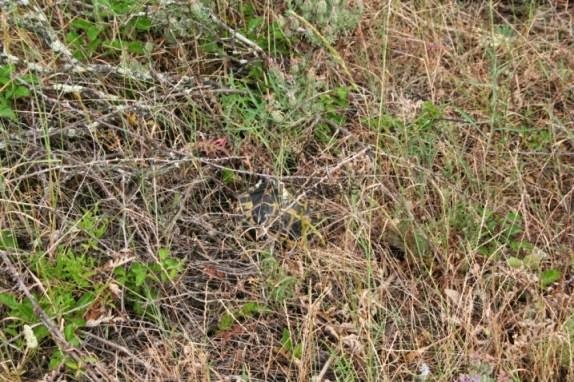
Is it possible then that the spots are useful for camouflage? In the pond where I have them they have the opposite effect, they make the turtle more visible. Do they make them more unnoticed in their natural habitat? I don't have the answer, but to assess camouflage you have to see the animal in the habitat. I saw it very clearly with   Testudo hermanni. This tortoise in a garden stands out, but in the habitat it is different


In the middle, it is difficult to see its shape


They are not always so well hidden, but they still ressemble the tones of the environment.


So, it would be interesting to see the Clemmys in their habitat, underwater and in land, to check if the spots help to make them unnoticed.

I have seen some pictures of the different type of wetlands in internet: vernal pools, marshes, swamps, bogs, fens... Some links with descriptions and pictures  of the different types.


It would also be interesting to see things from the perspective of their predators (racoons, skunks, otters...). We are a very visual species, we see in detail and many colors. Other species see differently. In a conference done  by the Societat Catalana d'Herpetologia (SCH), one talk was about sight in wall lizards. These lizards, like chelonians, see down to the UV spectrum. Females see tones in males that we don't perceive. The speaker talked about antropomorphism by omission: the one that takes place when by deffault we assume that the sensory abilities of the species that we study are similar to ours.
This is a link to the study, but I only found it written in Catalan.

http://roderic.uv.es/bitstream/handle/10550/23877/tesi_GuillemP%C3%A9rez_deLanuza.pdf?sequence=1

I remember a conversation with a  biologist that studies T. hermanni in the wild. Once they used trained dogs to count the number of tortoises in a territory.  He realized how differently do humans and dogs use vision. The dog was searching by scent and although it often passed near tortoises that the human eye catched easily,  the dog didn't see them. He found them by scent.
Something similar happens with cats.  Sometimes a cat sees a dog at some distance and stays completely quite, frozen. Very often the dog passes by without seing it. We, humans, use to see it.

dimarts, 15 d’octubre del 2013

Clemmys guttata (Schneider 1792): Etymology

In this website I found the etymology of the name Clemmys guttata. It says that Clemmys comes from the greek Klemmys (tortoise) and guttata from the latin gutta (gout)


Regarding Klemmys I coudn't find anything else, but regarding gutta, I found this interesting site


Interesting the botanic use of the word guttate for a leave with spots that look like water drops 

And looking for the origin of words, I wondered who was the Schneider that described Clemmys guttata for the first time in 1792. It was   Johann Gottlob Theaenus Schneider


But Schneider classified Clemmys guttata as Testudo gutatta. According to wikipedia the genus  Clemmys appeared in 1828 thanks to  Ferdinand August Maria Franz von Ritgen


It is also interesting the etymology of the word tortoise. Tortoise comes from latin tartaruchus that comes from the greek tartaroukös. Tartaroukös comes from Tartaros (hell) and Ekhein (inhabitant). People saw tortoises coming from underground or the mud of a pond and decided to call them creatures from hell, maybe not exactly a devil but anything good.

dimecres, 2 d’octubre del 2013

Growth

The male born in August 2011 is growing nicely. It looks as though new spots are appearing in the growth lines of the carapace, only on the marginal areas. 


Its tail is still very thin and the chin and face are not dark yet.


Although this is a Clemmys blog, today I will post some Testudo hermanni hermanni pictures.
Catalonia has a native population of the western subspecies. It is very protected and it is forbidden to keep Testudo hermanni,  never mind if they have been captive bred and have their CITES or they belong to the other subspecies, Testudo hermanni boettgeri.

The Catalan Environmental Department allows privates to collaborate in a captive breeding program of this species if some requirements (space, climate, security measures...) are achieved.  The CRARC are the ones that inspect the facilities and organize and control the captive breeding program. The animals that privates obtain are used in a reintroduction program in areas from Catalonia where this species lived before. They are not used to reinforce the places where the native species still survive. The CRARC are the ones that run this program, and the ones that organize and control the privates collaboration.
They borrowed me two males and three females, but the idea is to have 2 males and 8 females. They are kept in two separate groups.


Female with balearic fenotype


The key hole spot in V5, characteristic of this subspecies


This female has some pyramiding from previous owner (it could be a decomised animal)
This summer they have layed 2-3 times and the nests had between 4-6 eggs. I didn't notice some nests, but I knew they had layed for palpation. Most nests were in full sun but near the roots of plants and small bushes.

A nest on the top.middle of the picture, the ground with a different color
A picture nearer. The ground in the laying area is "sauló"
Another nest, under my shadow
Picking up the eggs of a nest

To increase the chances of success I incubated the eggs of more or less the half of the nests in a Jaeguer incubator.
For some reason, the eggs incubated naturally failed. The place where I have them falls in the potential natural range for the species, so I thought it was strange.
For comparison all the eggs in the incubator hatched. I know what to do next summer.


You can see the yellow spot on the face, characteristic of this subspecies
They are fed only weeds. This picture if from September the 30th, a very warm September (28ºC at noon)


I bath them so they can hydrate, but in hot days, I sometimes water the area with the goose. And they do the same that they do in a summer thunderstorm in the wild, they quickly drink from the pudles before the water filtrates.


 I will keep them untill they are more than 10 cm., so they pass the most vulnerable years. Then they will be released and they will be exposed to forest fire, predators (specially wild boars), humans... A few of them will reach adulthood, maybe none. 

I know there is a contradicion here. For one side  I keep chelonians for hobby, and this hobby is one of the causes of wild chelonian population depletion. On the other side  I collaborate in a breeding program to help the tortoises in the wild. Contradictory, like human nature.